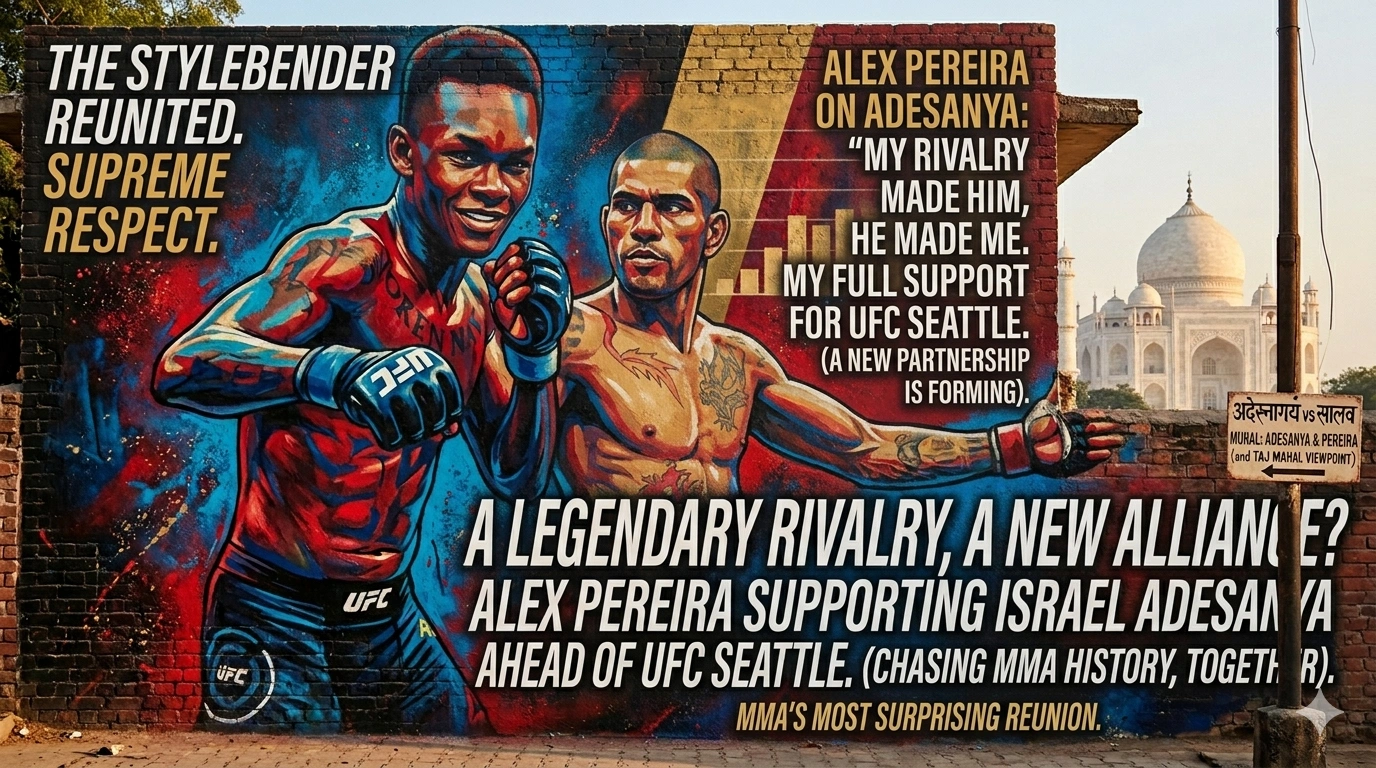
There is a particular kind of public gesture that cuts through the noise of fight week promotion and lands differently than anything a publicist could manufacture. On March 25, 2026, Alex Pereira posted a video on his Instagram account. Not a training highlight. Not a fight announcement. He posted the moment Israel Adesanya knocked him out at UFC 287 in April 2023 — the finish that cost Pereira the UFC middleweight title and handed Adesanya one of the most emotionally charged victories of his career — and wrote a message supporting his old rival ahead of Saturday’s fight at UFC Seattle.
The gesture landed immediately across the MMA world. Coming from a man who had beaten Adesanya three times across their combined kickboxing and MMA rivalry, who holds a 3-1 head-to-head record against him, and who was the fighter responsible for Adesanya’s first UFC middleweight title loss — the decision to share that knockout footage publicly, and to frame it as the moment that drove him to become a better version of himself, represented one of the more genuinely touching moments the sport has produced in recent memory.
Key Facts
- 📱 Pereira posted a video of his knockout loss to Adesanya at UFC 287 on his Instagram, alongside a written message of support ahead of UFC Seattle on March 28.
- 🤝 Pereira and Adesanya have shared a cordial public dynamic since their rivalry concluded — including a viral moment at UFC 312 last year where both fighters were seen interacting warmly at the event.
- 📉 Adesanya enters UFC Seattle on a three-fight losing streak — his first losing run in UFC competition — and has not won a fight since knocking out Pereira at UFC 287 in April 2023.
- 🏆 Since that loss, Pereira has gone on to become a two-time UFC light heavyweight champion and is now preparing to fight Ciryl Gane for an interim heavyweight title at UFC Freedom 250 in June.
- 🥊 Adesanya faces Joe Pyfer in the main event of UFC Fight Night 271 at the Climate Pledge Arena in Seattle, Washington on Saturday, March 28.
- 💬 Adesanya has said separately that he feels the sport did not fully appreciate how active and committed he was during his championship reign — and that watching the division from the sidelines has reinforced that perspective.
Why This Message Means More Than It Looks
Combat sports has never been short of manufactured respect — the post-fight hug that follows a five-round war, the press conference handshake that gets photographed and forgotten. What Pereira did on Wednesday is categorically different. He chose to revisit a loss publicly, in a context where nothing professional required him to do so, and attributed his entire upward trajectory since that night to what he learned from the man who handed it to him.
The message is also specific in a way that distinguishes it from a generic well-wish. Pereira does not simply say good luck. He describes a process — growing, maturing, using a painful defeat as fuel. He frames the Adesanya fight not as a setback to be overcome but as a defining moment of evolution. And he addresses Adesanya directly as “Chama” — a Brazilian Portuguese term of endearment roughly equivalent to “brother” or “mate” — a word that carries an intimacy that the public nature of their rivalry had never previously allowed to surface.
The Rivalry in Full: Four Fights Across Two Sports
To understand why Pereira’s message carries the weight it does, the history between these two fighters needs to be understood in its full context. Their rivalry did not begin in the UFC. It began years earlier in the world of professional kickboxing, where Pereira — then competing in GLORY Kickboxing — defeated Adesanya twice. Those wins, achieved before either man had established themselves in MMA, planted the first seeds of a professional relationship built on mutual awareness of exactly how the other performs under maximum pressure.
When Pereira followed Adesanya into the UFC and ultimately took his title at UFC 281, the rivalry reached a level of narrative complexity that the sport rarely produces. Adesanya’s revenge at UFC 287 — a clean, decisive knockout in the second round that silenced any remaining questions about who had gotten the better of whom — was the final chapter of one of MMA’s most compelling multi-sport storylines. Pereira left that fight with a loss, a former title, and — by his own account this week — a lesson that he used to become something greater.
Diverging Paths Since UFC 287
The contrast between where these two fighters have arrived since their last fight three years ago is one of the most striking career divergence stories in recent UFC history. Pereira responded to the UFC 287 loss by moving to light heavyweight, where he has since won and defended the title twice, becoming one of the sport’s most commercially dominant and athletically fearsome forces. He is now preparing to fight Ciryl Gane for the interim heavyweight title at UFC Freedom 250 on the South Lawn of the White House in June — a fight that, if he wins, would make him the first fighter in UFC history to hold championships in three different weight classes.
Adesanya’s path since that same night has moved in the opposite direction. He went on to lose the middleweight title to Sean Strickland at UFC 293, failed to reclaim it against Dricus du Plessis at UFC 305 in a fourth-round submission, and then suffered a knockout loss to Nassourdine Imavov in February 2025. The three-fight losing skid is the first of his UFC career. The questions surrounding his future at 36 years old are genuine and persistent. Saturday in Seattle against Joe Pyfer is, by any reasonable assessment, one of the most important fights of his career.
What Adesanya Said About His Own Legacy
Pereira’s message arrived in the same week that Adesanya gave an interview to ESPN in which he addressed the feeling of being undervalued during his championship reign — a sentiment that added context to the scale of what Pereira’s public support represents. Adesanya reflected on how active he was as champion, how willing he was to take on the best available challengers, and how watching the division from the outside during his losing streak had given him a new appreciation for what he had built during the years he held the belt.
He described the middleweight division as slow and stuck without him — a statement that carries both confidence and a tinge of something more vulnerable, the kind of honesty that a fighter only voices when they are far enough removed from the moment to see it clearly. It is the voice of a man taking stock. Pereira’s message, arriving in the middle of that same week, felt less like a promotional gesture and more like a genuine acknowledgment from one combat sports veteran to another that the work they put in, the fights they shared, and the moments they created together had lasting significance beyond whatever the record books say.
Alex Pereira posting his own knockout loss to support the man who landed it is not something the fight promotion machine generates. It is what happens when two competitors, who have pushed each other to the absolute limit across four fights and two sports, arrive at a place of genuine mutual respect. Pereira’s trajectory since UFC 287 is proof that losing to Adesanya made him better. Whether Adesanya can use that same energy to make himself better again on Saturday night in Seattle is the only question that matters this weekend.
What Happens Next for Both Men
For Adesanya, Saturday’s fight against Pyfer is the clearest line in the sand his career has presented in years. A win ends the losing streak, keeps him in the middleweight title picture, and potentially opens the door to the kind of late-career narrative arc that combat sports does better than almost any other form of athletic competition. A loss raises questions about whether the end is closer than anyone wants to acknowledge for a fighter who, at his best, was one of the most technically brilliant competitors the middleweight division has ever produced.
For Pereira, the focus has already shifted to June. The White House heavyweight title fight against Gane is the next chapter of what has become one of the most accelerated and commercially successful career second acts in UFC history. He will be watching Seattle with a genuine rooting interest — one he made very public, and very personal, with a single Instagram post on a Wednesday afternoon that the MMA world will not forget in a hurry.