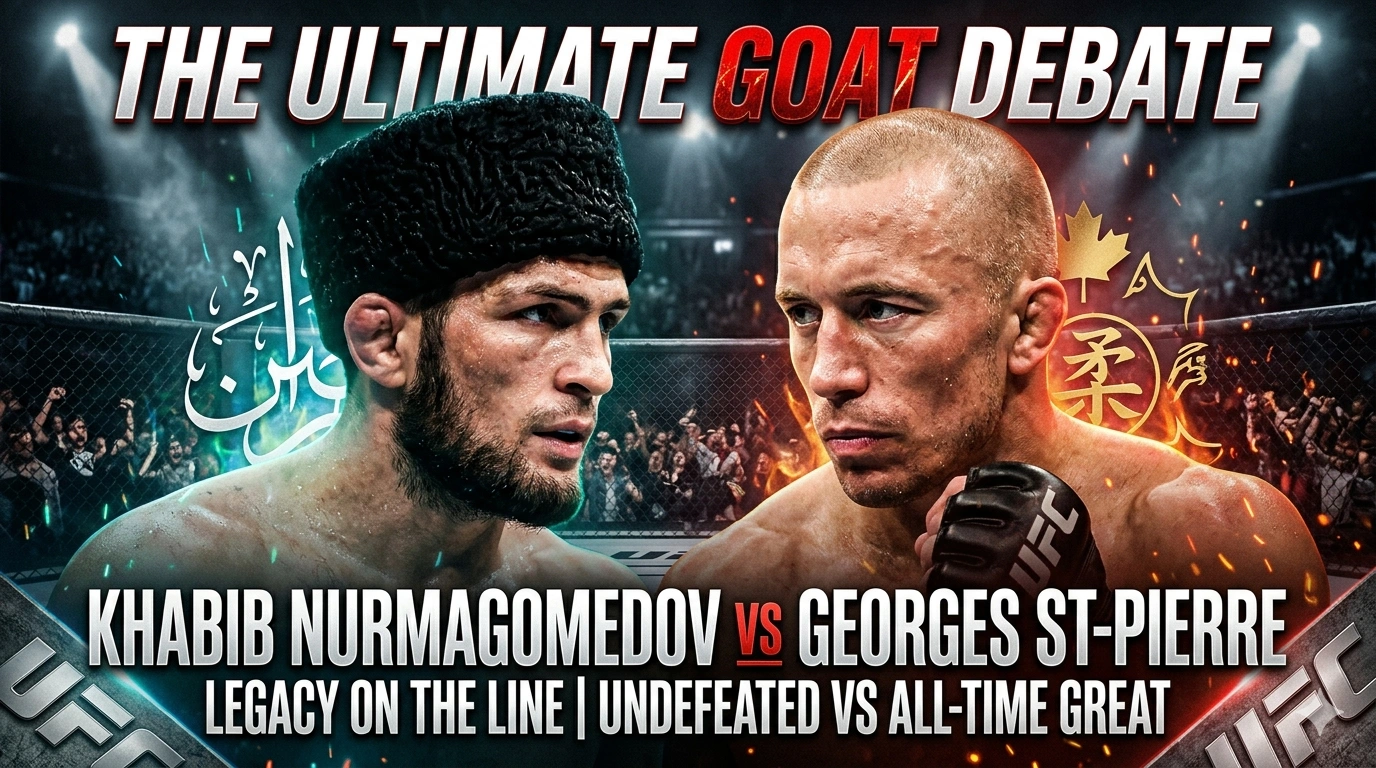
Two names dominate every serious MMA GOAT conversation. Khabib Nurmagomedov — the Eagle from Dagestan, 29-0 and never once taken down, never once finished, a force of grappling nature so absolute that opponents stopped trying to fight him on the ground and lost to him standing up instead. Georges St-Pierre — Rush from Montreal, 26-2 and arguably the most complete mixed martial artist in the history of the sport, a two-division champion who held the UFC welterweight title for 2,204 days and defended it nine consecutive times — the most in welterweight history.
They never fought. They came close — Khabib called out GSP after winning the lightweight title in 2018, GSP declined citing health issues — and that uncompleted chapter is one of MMA’s great “what ifs.” What we can do is compare every number, every defining fight, every dimension of skill and legacy side by side. This is the most thorough comparison you will find anywhere.
The Rise of Two Legends
Khabib Nurmagomedov: The Eagle of Dagestan
Khabib Abdulmanapovich Nurmagomedov was born in the village of Sildi in Dagestan in 1988 and began wrestling as a young child under the guidance of his father, Abdulmanap — himself a former wrestler and decorated coach. Before he was a teenager, he was wrestling bears as a training exercise. By the time he turned professional in 2008, he had already developed the complete wrestling and grappling foundation that would make him virtually undefeatable as an adult.
His path to the UFC was built through the regional circuits of Russia and Ukraine, where he went 16-0 before signing with the UFC in 2012. What followed was a journey repeatedly interrupted by injuries and weight-cutting complications, but his performances — dominating elite opponents like Rafael dos Anjos, Michael Johnson, Edson Barboza and Conor McGregor — were so one-sided that the division had effectively accepted its fate before he even won the title. In 13 UFC fights, he was never taken down, never knocked down, never submitted, and never came close to losing a round on any judge’s scorecard.
Georges St-Pierre: The Complete Fighter from Quebec
Georges St-Pierre grew up in Saint-Isidore, Quebec, where he began training Kyokushin karate as a child partly in response to being bullied at school. He earned his black belt at 12 and was competing in MMA by his teens. His professional debut came in 2002, and his rapid progression through the welterweight division led to a UFC title shot against Matt Hughes in 2004 — a fight he lost, but one from which he drew the lessons that would define everything that followed.
GSP’s evolution from 2004 to 2008 is one of MMA’s great development stories. He added elite-level wrestling to his karate base, developed one of the sport’s finest jabs and ground-and-pound attacks, and absorbed lessons from coaches across multiple disciplines to become, by the time of his second title reign, the most complete mixed martial artist the sport had produced. He went 13-0 in title fights — more than any other fighter in UFC history — and defended the welterweight belt nine consecutive times.
29-0: The Perfect Record That May Never Be Matched
Khabib retired with a perfect 29-0 record — including 13-0 in the UFC — after submitting Justin Gaethje in the second round of UFC 254. He was ranked the No. 1 pound-for-pound fighter in the world at the time of his retirement. In his entire MMA career, not one opponent ever took him down, not one opponent ever submitted him, and not one opponent ever came close to finishing him. The scale of that dominance across 12 years of professional competition has no precedent in the sport.
GSP’s Two Losses: The Learning Points that Built a Champion
GSP’s two professional losses came against Matt Hughes in 2004 (submission, Round 1) and Matt Serra in 2007 (TKO, Round 1) — the latter widely considered one of the biggest upsets in UFC history. Both losses came early in his development. What followed each loss was a period of dedicated work that made him markedly better. After losing to Hughes, he went 10-0 before claiming the title. After losing to Serra, he went 13-0 without defeat. His ability to absorb setbacks and come back stronger is central to his GOAT credentials.
Never Taken Down: The Most Remarkable Statistic in MMA
In 29 professional fights spanning 12 years against elite competition, Khabib Nurmagomedov was never once successfully taken to the mat by an opponent. He faced decorated wrestlers, elite BJJ practitioners and Olympians — and not one of them could execute a takedown against him. Combined with his own takedown output of over 5 per 15 minutes, his grappling imbalance over opponents was the most extreme in the history of the sport.
GSP: 82% Takedown Accuracy — A UFC Record
Georges St-Pierre holds the UFC record for takedown accuracy at 82% — meaning when he shot for a takedown, he completed it four times in five attempts. He also landed 90 total UFC takedowns, a record that stood for years. His wrestling was not the explosive, high-volume style of Khabib — it was surgical. He timed his shots perfectly, used his jab as a setup, and almost never missed. His ground-and-pound from top position was also among the most controlled and effective in welterweight history.
GSP: The More Complete Striker
Georges St-Pierre’s striking was built around a Kyokushin karate base refined through world-class boxing and Muay Thai coaching. His jab — long, fast, and blinding — was one of the best in the division and set up his takedowns perfectly. His side kick, spinning back kick, and head kick combinations made him unpredictable standing up. He absorbed fewer strikes per minute than Khabib (2.33 vs 3.53) and was more defensively responsible on the feet, which reflects his superior movement and combination of distance management and technical variety.
Khabib’s Striking: Underrated and Overlooked
Because Khabib’s grappling was so dominant, the quality of his striking is often overlooked. His combination work against Conor McGregor — widely considered the best striker he faced — showed a fighter who could operate effectively on the feet against an elite standup opponent. His boxing accuracy of 49% was higher than McGregor’s (52% is one of the best in the division). His striking from top position — the “Khabib ground and pound” — was relentless and technically efficient, wearing opponents down methodically rather than going for the dramatic finish.
GSP: 2,204 Days as UFC Champion Across Two Weight Classes
Georges St-Pierre held the UFC Welterweight Championship from November 2006 to December 2013 — a combined reign spanning 2,204 days, the second longest in UFC history. He defended the title nine consecutive times, beating Jon Fitch, BJ Penn, Thiago Alves, Josh Koscheck (twice), Dan Hardy, Jake Shields, Carlos Condit, and Johny Hendricks. He then returned in 2017 to claim the Middleweight Championship at UFC 217, becoming only the fourth fighter in UFC history to hold titles in two divisions simultaneously.
Khabib: Retired Undefeated and Unchallenged as Champion
Khabib Nurmagomedov won the UFC Lightweight Championship in April 2018 by defeating Al Iaquinta, then defended it three times — against Conor McGregor (submission, round 4), Dustin Poirier (submission, round 3), and Justin Gaethje (triangle choke, round 2). He retired at UFC 254 after the Gaethje fight, citing his promise to his late father. He vacated the title still undefeated, having never lost a single round on a judges’ scorecard in his three title defenses. He was the No. 1 pound-for-pound fighter in the world at the time of his retirement.
The GOAT Verdict
Khabib wins on purity. A 29-0 record, never taken down, never finished, never seriously challenged — the most dominant career in the history of MMA. His perfection is unmatched and likely unmatchable.
GSP wins on completeness and longevity. Two UFC titles, nine consecutive welterweight defenses (a division record), 2,204 days as champion, and the most wins in title fights (13) in UFC history. He was voted the greatest pound-for-pound MMA fighter ever by The Athletic’s fighter survey — the peers who know best.
Khabib wins in…
Perfect record, never finished or taken down, grappling supremacy, No. 1 P4P at retirement, and the most dominant individual style in MMA history.
GSP wins in…
Title defenses (9), two divisions, 2,204 days as champion, 13 title fight wins (UFC record), overall skill completeness, and peer-voted GOAT status.
Grappling: The Core of Both Games
Both fighters built their careers on elite grappling, but the expression of that grappling was fundamentally different. Khabib’s grappling was a smothering, overwhelming force — he did not just take opponents down, he buried them there, cycling between positions, absorbing their escape attempts while landing ground-and-pound, and grinding the physical and mental fight out of anyone he faced. His Sambo background gave him a unique toolkit: the ability to control from unusual positions, to transition between wrestling and submission attacks with fluidity, and to maintain top control against even elite BJJ practitioners.
GSP’s grappling was surgical and efficient. His 82% takedown accuracy — a UFC record — meant that when he shot, the fight went to the ground. His ground-and-pound was controlled and constant rather than explosive, designed to accumulate damage and fatigue rather than secure a dramatic finish. His BJJ black belt gave him the submission threat that kept opponents from committing fully to their stand-up game. The combination of wrestling precision and positional control made him essentially impossible to fight competitively on the ground.
Striking and Overall MMA Skill
In the dimension of overall MMA skill, GSP’s case as the more complete fighter is strongest. His Kyokushin karate base gave him a striking vocabulary that was genuinely unusual in MMA — front kicks, side kicks, spinning back kicks — combined with clean boxing technique and an elite jab that he used to set up both his takedowns and his combinations. Against Condit, Koscheck, and Penn, he demonstrated the ability to control standing exchanges against quality strikers as completely as he controlled wrestling exchanges.
Khabib was a more limited but still effective striker who improved throughout his career. His work against Edson Barboza — a dangerous kickboxer — in 2017 showed a fighter who could control range and negate striking threats through pressure. His exchanges with McGregor on the feet, though relatively brief before the fight went to the ground, showed he was comfortable and capable standing. The honest assessment is that Khabib’s striking, while solid, was a complement to his grappling rather than an equal weapon. GSP’s striking was genuinely elite — capable of winning a fight on its own.
Title Reigns and Division Dominance
In terms of championship longevity and title defense record, GSP has no equal in UFC history among welterweights or lightweights. His nine consecutive defenses of the welterweight title — from November 2008 to December 2013 — represent the most sustained period of championship dominance in a single division the sport has ever seen. He defended against ranked opponents in every division fight, never taking a soft touch, and he won every single one of them convincingly, often by wide decision margins.
Khabib’s three title defenses look modest by comparison in terms of number, but the quality of those three defenses was exceptional. Conor McGregor at UFC 229 was the biggest pay-per-view event in MMA history (2.4 million buys). Dustin Poirier was a top-ranked contender. Justin Gaethje was the interim champion and one of the most dangerous fighters in the division. He dispatched all three in dominant fashion and retired with the belt. Both men leave as champions — but GSP’s combined championship reign of 2,204 days across two divisions is a longevity record no other fighter can claim.
The Defining Fights That Made Their Careers
Khabib’s Defining Fights
Khabib vs Conor McGregor — UFC 229, October 2018
The biggest fight in MMA history drew 2.4 million pay-per-view buys — still a record. McGregor came in having trash-talked Khabib’s father, religion, and nationality for months. In the cage, Khabib controlled the first two rounds on the ground almost completely, absorbed a dangerous third round from McGregor on the feet, and then submitted him in the fourth with a neck crank. The post-fight brawl that followed — Khabib leaping the octagon fence — was chaotic, but the performance inside the cage was one of the most dominant title fight showings in history against one of the most celebrated combat sports stars ever.
Khabib vs Justin Gaethje — UFC 254, October 2020
Gaethje came in as interim champion, undefeated since a self-described career reset, and widely considered the most dangerous man in the lightweight division. The first round was genuinely competitive — Gaethje’s leg kicks and jab kept Khabib honest. In the second, Khabib landed a takedown, transitioned to a triangle choke, and Gaethje tapped at 1:34. After the fight, Khabib sat in the octagon, removed his gloves, and delivered an emotional post-fight speech before announcing his retirement. It was the last fight of a perfect career.
GSP’s Defining Fights
GSP vs Matt Serra II — UFC 83, April 2008
After losing to Serra in one of the biggest UFC upsets ever, GSP had worked for a year on the mental and physical failures that led to the loss. The rematch was held in front of 22,000 people in his hometown of Montreal — the first UFC event in Canada. He took Serra down in the second round, delivered devastating ground-and-pound, and stopped him with punches. The emotion in the Bell Centre that night was unlike anything Canadian sport had seen. The win began a run of 13 consecutive victories that ended only with his retirement.
GSP vs Michael Bisping — UFC 217, November 2017
After four years away from MMA — citing anxiety, burnout, and mental health challenges — GSP returned at 36 to challenge for the middleweight title against Bisping, moving up 15 pounds in weight. He won by third-round submission, becoming only the fourth fighter in UFC history to win titles in two divisions and the first to win them non-consecutively. The performance was a technical masterclass — controlling distance, using his jab, taking Bisping down methodically — and the comeback narrative made it one of the most celebrated victories in UFC history.
The GOAT Argument: Making the Case for Both
The Case for Khabib as the Greatest
The case begins and ends with the record. A 29-0 career without a single loss, a single knockdown, or a single successful takedown against him is a statistical profile that has no parallel in the sport. When you add that he was ranked the No. 1 pound-for-pound fighter in the world at the time of his retirement — having achieved that ranking by defeating elite opponents across a 12-year professional career — the argument for his greatness is extremely powerful. FightMatrix ranks him as the No. 1 lightweight of all time. His grappling was the most dominant expression of a single skill set in MMA history.
The counterargument focuses on career length and breadth. He competed in only 13 UFC fights and defended the title just three times before retiring. He fought in a single weight class against opponents who knew exactly what style they were facing. His relatively short championship reign, compared to GSP’s 2,204 days, means the argument that he could have maintained that dominance across a longer career remains, ultimately, unresolved.
The Case for GSP as the Greatest
GSP’s case rests on three pillars: completeness, longevity, and versatility. He was the most complete MMA fighter of his era — equally dangerous on the feet, in the clinch, and on the ground, with elite-level skills in at least four distinct disciplines. He held a world title for 2,204 combined days across two weight classes. He won 13 title fights — an all-time UFC record. In The Athletic’s survey of MMA fighters asked to name the greatest pound-for-pound fighter in history, GSP received more votes than any other fighter — the assessment of the people who know the sport most intimately.
The counterargument is that he lost twice, and that his later performances — particularly the controversial split decision over Johny Hendricks in 2013 that many observers thought he lost — suggested a fighter who had been pushed very close to his limits by elite competition, which Khabib never appeared to be.
Legacy Beyond the Octagon
Khabib’s legacy extends well beyond his fighting record. He is the most-followed Russian on Instagram with over 34 million followers, and The Guardian named him the second most popular Muslim athlete in the world in 2020. He founded Eagles MMA and the Eagle Fighting Championship, and has dedicated his post-fighting career to coaching and developing fighters — including his cousin Usman Nurmagomedov, who became Bellator lightweight champion. His father’s death from COVID-19 complications in 2020 added a profound emotional dimension to his retirement and his ongoing work as a coach — carrying on Abdulmanap’s legacy has become his primary purpose.
GSP’s post-fighting life has been equally varied. He has appeared in major Hollywood productions including Captain America: The Winter Soldier, has built a significant business career, and remains one of the UFC’s most accessible and intellectually engaging ambassadors. He has spoken candidly about the mental health challenges that led to his first retirement — anxieties, insomnia, and claustrophobia that developed over years of championship pressure — and his willingness to discuss those struggles publicly gave a human dimension to a career that might otherwise have seemed impossibly polished.
Both men entered the UFC Hall of Fame — GSP in 2020, Khabib in 2022. Both are regarded by virtually every credible MMA analyst as among the five greatest fighters in the sport’s history. The debate between them is not about whether either was great — it is about what definition of greatness matters most: perfection, or completeness. That debate has no final answer. Which is precisely what makes it the best debate in MMA.
Read more here.