“Venom” Page
DECISION
3 ROUNDS · WELTERWEIGHT
Patterson
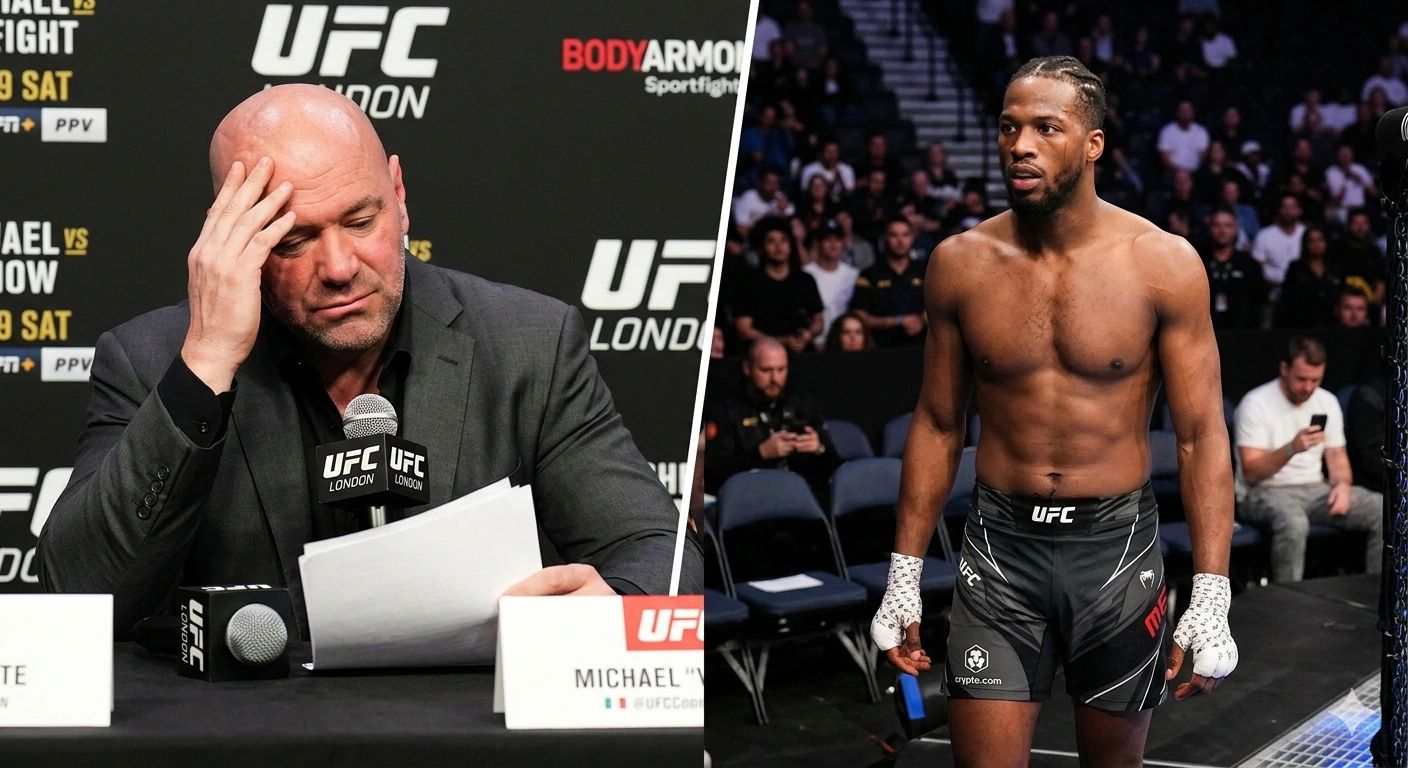
The win will go into the record books. The performance will go into a different kind of file entirely. Michael Venom Page returned to welterweight at UFC London on Saturday night, fought a fellow Englishman he trains with, and produced three rounds of such minimal action that the O2 Arena — a crowd that had arrived chanting his name — was booing loudly before the first round was over. Dana White reportedly left the arena before the final bell. And Page, rather than absorbing the criticism quietly, turned the post-fight press conference into a public message directed squarely at the UFC president.
The scorecards read 30-27, 29-28 and 29-28 in Page’s favor. The numbers behind those scorecards told a different story. Across three rounds of professional combat at one of the sport’s marquee annual events, Page landed 33 strikes from 61 attempts — a total that most fighters exceed inside a single competitive minute. Patterson’s output was similarly subdued. Between them, fewer than 40 meaningful strikes landed across the entire fight. It was, by almost any measure, among the least eventful main card bouts in the history of the UFC’s London franchise.
Key Facts
- 📋 Official scorecards: 30-27, 29-28, 29-28 — unanimous decision for Page. Page improved to 4-1 in the UFC and 25-3 overall.
- 👣 Dana White reportedly got up and walked out of the arena during the fight — a gesture that drew widespread media coverage and significant social media attention before the final bell had even rung.
- 📣 The O2 crowd booed loudly across all three rounds — including during the first round, which was described by multiple ringside journalists as one of the least active opening frames in recent UFC main card history.
- 🎙️ At the post-fight press conference, Page responded to White’s walkout directly, saying White needs to be more mindful of his actions given the scale of his public influence — and added that next time he would make White stay in his seat.
- 🔄 Page moved back to welterweight after two middleweight wins over Shara Magomedov and Jared Cannonier in 2025. His only UFC loss came against Ian Machado Garry.
- 🤝 Page and Patterson are frequent training partners — a dynamic both fighters acknowledged publicly before the fight, and one that many observers believe contributed to the lack of aggression inside the cage.
What Actually Happened Inside the Cage
The fight began with an atmosphere that few UFC London cards had matched for noise and expectation. The chants of MVP rolled around the O2 before the opening bell and Page fed off them with his trademark showmanship — the exaggerated footwork, the wide stance, the feints designed to make opponents second-guess their own positioning. Against most opponents, that opening sequence eventually leads somewhere. Against Patterson, it led to a round in which almost nothing happened at all.
Page worked from distance, feinted constantly, and looked for the single clean shot rather than building combinations. Patterson circled, measured his entries, and showed none of the forward urgency that the crowd was demanding. The round ended with both fighters having barely committed to a single sustained exchange. The boos began. They did not stop for the remainder of the evening.
The second round introduced slightly more engagement, primarily through the clinch, but neither fighter produced the kind of moment that shifts crowd energy in a positive direction. Page caught Patterson with a short right hand with about 28 seconds remaining in the round — his cleanest strike of the night — but the exchange was too brief and too isolated to change the atmosphere inside the arena. The third round featured more clinch work and a late flurry from Page that came to nothing. When the final buzzer sounded and the scorecards were read, the noise level at the O2 was not that of a crowd welcoming a winner home.
The Official Scorecards
| Judge | Score | Winner |
|---|---|---|
| Judge 1 | 30–27 | Page |
| Judge 2 | 29–28 | Page |
| Judge 3 | 29–28 | Page |
Why the Training Partner Dynamic Mattered
The context behind this matchup is important for understanding why the performance unfolded the way it did. Page and Patterson are not simply acquaintances from the same general gym community — they train together regularly, know each other’s tendencies in granular detail, and had spoken publicly before the fight about the unusual dynamic of competing against someone you work alongside. Page acknowledged in pre-fight interviews that when ranked opponents declined the bout, Patterson himself reached out after being offered the fight, noting the awkward coincidence that his name had come up as a potential opponent.
The result of two fighters with deeply familiar knowledge of each other’s games, neither of whom wanted to invest significant physical capital against someone they train with, was a fight that never found the kind of friction that produces memorable exchanges. Patterson’s game plan — staying measured, avoiding big risks, forcing Page to come to him — was tactically sensible but commercially disastrous. Page’s approach — feinting, holding distance, picking moments — is the kind of strategy that works brilliantly when an opponent is rattled and poorly when an opponent is calm and unsurprised by every movement.
Dana White Walks Out — and Page Fires Back
The post-fight story dominated almost as much as the fight itself. Reports emerged quickly that White had left the arena during the bout rather than watching it to conclusion — a gesture loaded with implicit criticism that required no accompanying statement to communicate its meaning. When the media asked White directly about the performance at the post-event press conference, he did not attempt to soften the response. He described it as a bad fight, acknowledged he was not impressed, and offered no indication of what comes next for Page with a brevity that carried its own message.
Page addressed White’s behavior at his own post-fight media session in terms that were measured but pointed. He stated that White, as a man in his position, needs to be aware that his actions carry significant weight and create larger consequences than those of a private individual. He said White needs to be more mindful of what he does and how it reads publicly. And he concluded with a statement that was part challenge and part promise: next time, he would make White stay in his seat. Whether that next time comes — and in what form — is now the central question hanging over Page’s UFC future.
Michael Venom Page is 4-1 in the UFC. He has wins over Shara Magomedov, Jared Cannonier, and now Sam Patterson — names that carry genuine middleweight and welterweight credibility. His only loss came against Ian Machado Garry in a fight that was competitive and legitimate. None of that changes the reality of Saturday night: he landed 33 strikes in three rounds in front of his home crowd, the CEO of his employer walked out of the building, and the post-fight narrative belonged entirely to things that happened outside the cage. A fighters’ job is to make the promoter want to keep showing up. At UFC London, Page did the opposite — and the consequences of that, commercially and contractually, remain entirely unclear.
What Comes Next
The welterweight division is deep and competitive, and a 4-1 record with a performance that generated this level of negative attention does not put Page in a strong position when it comes to negotiating his next assignment. White’s press conference comments — a brief, dismissive acknowledgment followed by a shrug — did not suggest the UFC is rushing to build around Page as a marquee name at 170 pounds.
Names discussed in post-fight conversation for Page’s next opponent ranged from lower-ranked welterweights who might generate a more active and entertaining matchup to a potential rematch with Ian Machado Garry — the only fighter to beat Page in the UFC — whose stock has risen considerably since their encounter. Gilbert Burns, who commented on social media during UFC London expressing his frustration with the fight’s pace, has also been floated. Whatever the next step is, one thing is agreed upon by almost everyone watching: it needs to look and feel entirely different from what happened at the O2 on Saturday night.