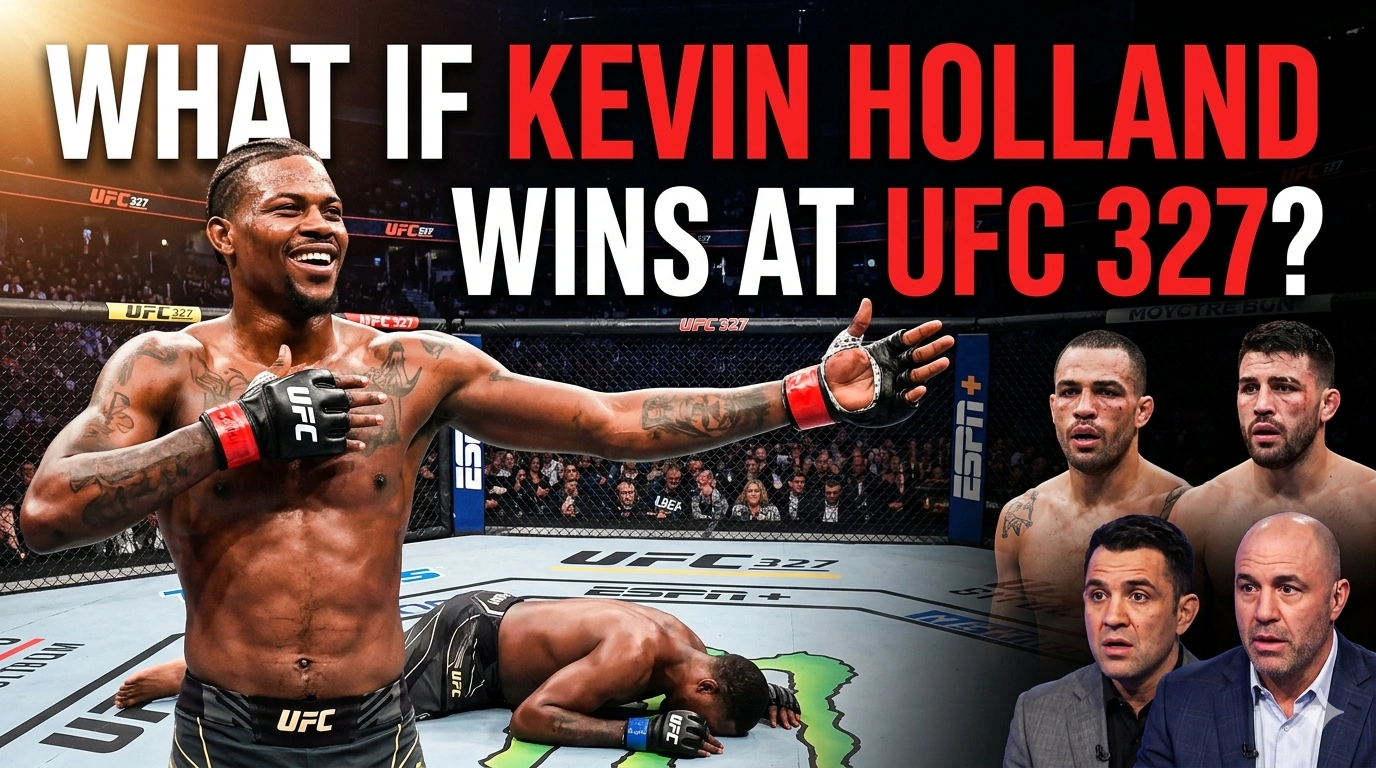
There is no fighter in the UFC quite like Kevin Holland. Not in terms of personality, not in terms of approach, and certainly not in terms of what any given night with him inside the cage can produce. He has knocked people out from his back.
He has submitted opponents with techniques that heavyweights do not usually attempt. He has talked his way through entire fights while simultaneously winning them.
He has also lost fights in ways that defy reasonable explanation — competitive, well-prepared, occasionally dominant on the feet and still ending up on the wrong side of the scorecards.
On April 11 at UFC 327 in Miami, Holland faces Randy Brown on the preliminary card at the Kaseya Center. He enters on back-to-back losses.
His record stands at 28-15 overall and 15-12 in the UFC. He is 33 years old. The conventional narrative for a fighter in that position is that the window is closing and each loss makes the next one harder to come back from.
Kevin Holland does not do conventional narratives. And the question of what happens if he wins at UFC 327 is more interesting than his record number might suggest.
What Holland Said at UFC 327 Media Day
Holland met the media on Wednesday ahead of UFC 327 and gave the press conference the specific flavour of honesty mixed with confidence that makes him one of the most entertaining fighters to cover.
Asked about his two-fight losing streak, he did not deflect or make excuses. He addressed it directly.
“They don’t feel like losses, but at the end of the day, they are losses,” Holland told MMA Junkie. “It doesn’t feel like I lost a combat match, but I lost a competition. Got to get it right competition-wise.”
That distinction — between losing a combat match and losing a competition — is genuinely Holland’s way of thinking about his performances.
He is a fighter who measures nights by the quality of the fight he produced rather than by the scorecards, and there is something authentic about that.
It is also, simultaneously, the exact mindset that can be the difference between a fighter who adjusts and a fighter who does not. Holland knows the difference. Whether he acts on it at UFC 327 is the central question of this fight.
He was also direct about his approach to Randy Brown.
“Ultimately, the guy has called me out a few times, and they always have this code, ‘Don’t fight another guy like you.’ Then they want to fight,” Holland said. “So I’ll give them what they want, and I’m going to mess him up.”
The Full Kevin Holland Story — From Riverside to the UFC Roster
A Childhood That Built a Fighter
Kevin Holland was born on November 5, 1992 in Riverside, California and raised mostly by his grandparents in Rancho Cucamonga and Ontario.
His mother spent time in and out of jail. His father has been incarcerated throughout Holland’s life. He grew up in circumstances where developing toughness was not optional — it was simply what survival required.
He started martial arts training at sixteen. He had watched UFC 100 while visiting his father in Philadelphia and fell in love with the sport immediately.
Georges St-Pierre was his first idol. He attended Los Osos High School and Chaffey College, and he began developing the Kung Fu-influenced striking base that would eventually become one of the most distinctive skill sets in the welterweight division.
He went 5-0 as an amateur. He turned professional in 2015. The path from Riverside to the UFC was not straight or smooth, but it was built on an activity level and a willingness to fight that very few athletes in any sport match.
The UFC Career — Five Wins in 2020 and the Record Books
Holland’s UFC career began at middleweight in 2018 with a loss to Thiago Santos. He found his footing over the following two years and in 2020 produced one of the most remarkable single-year performances in UFC history — five wins in one calendar year, tying the all-time UFC record for wins in twelve months.
The highlight of that run was a knockout of Ronaldo “Jacare” Souza at UFC 256 that remains one of the most replayed moments in recent UFC history.
Holland was on his back when he landed the punch. From his back. Knocking out a Brazilian jiu-jitsu legend who had been dangerous for two decades. From his back.
He earned Performance of the Night bonuses throughout 2020. He earned BT Sport’s Male Fighter of the Year.
He entered 2021 as one of the most exciting fighters in the UFC and the middleweight division’s most unpredictable threat.
Then the inconsistency that has defined the second half of his career began. Losses to Derek Brunson, Marvin Vettori, and a brutal period where his results stopped matching his talent.
He moved between middleweight and welterweight, picking up wins and losses in equal measure, staying busier than almost every other active UFC athlete, and building a resume that nobody in the sport can quite categorise correctly.
The 2025 Rollercoaster
Holland’s 2025 campaign was another example of the specific Holland pattern — bursts of brilliance surrounded by results that make no sense given what he can do.
He started the year with a first-round submission loss to Reinier de Ridder at UFC 311. Then he won a unanimous decision over Gunnar Nelson in London and earned a Performance of the Night bonus.
Then he submitted Vicente Luque with a D’Arce choke at UFC 316 — another Performance of the Night bonus and arguably his most impressive submission finish since the Jacare knockout.
Then he lost a unanimous decision to Daniel Rodriguez. Then he lost a unanimous decision to Mike Malott.
Five fights in 2025. 2-3. Two bonuses. Two wins over quality opponents. Two losses over quality opponents. One loss to a submission specialist. That is Kevin Holland in 2025 in a paragraph.
He enters UFC 327 on a two-fight losing streak at welterweight, needing a win and knowing it.
Who Is Randy Brown and Why This Fight Is Harder Than It Looks
The Rude Boy’s Credentials
Randy Brown is 20-7 overall and 14-7 in the UFC. He is Jamaican-American, fights out of American Top Team, and has spent the last several years building a reputation as one of the most consistently dangerous unranked welterweights on the UFC roster.
He is 6’3″ with a long reach, a crisp technical boxing style and the kind of finishing power that his nickname — Rude Boy — suggests.
His recent run includes a one-punch knockout of Nicolas Dalby that was one of 2025’s most violent finishes, a split decision loss to Bryan Battle that many felt he won, and a second-round stoppage loss to Gabriel Bonfim in his first-ever UFC main event appearance in November. He too enters this fight on a loss and looking for a statement.
Brown responded to Holland’s media day comments with a dismissiveness that is, honestly, quite well-reasoned.
“He needs some kind of motivation,” Brown told MMA Junkie. “I never need motivation. I don’t care if we’re cordial. You’re not my friend. I don’t give a damn.
We can fight today, we can fight tomorrow. I can smile and break your face with a smile on my face. This is gladiator school. We don’t come here for friends.”
That is a fighter who is not rattled by Holland’s psychological game, which has worked against some opponents and done nothing against others.
Brown’s technical boxing and movement give him a genuine path to winning this fight on the scorecards even without a finish.
The Matchup Dynamics
Both men are 6’3″ at welterweight — unusual physical specimens for a division where most fighters are between 5’10” and 6’1″.
Holland has an 81-inch reach advantage that he can weaponise with his unorthodox southpaw-influenced striking, but Brown has the technical discipline to neutralise reach advantages with footwork and timing in a way that many of Holland’s recent opponents have not.
Holland’s grappling has genuinely evolved into one of the most dangerous submission games in the welterweight division.
Nine of his 28 professional wins have come by submission — D’Arce chokes, guillotines, armbars, triangle chokes.
For a 6’3″ striker who started training at sixteen, that is an extraordinary submission record and one that keeps opponents honest about the grappling dimension even when Holland appears to be purely a striking threat.
Brown’s path to victory runs through technical boxing and movement. Holland’s path runs through chaos, pressure and the submission threat that emerges when the fight gets dirty in the clinch or on the ground.
What Holland Wins at UFC 327 Actually Unlocks
He Stops the Bleeding on a Two-Fight Skid
The most basic and immediate consequence of a Holland win at UFC 327 is that it stops a slide that, if it continued to a third consecutive loss, would create genuine questions about his future in the UFC.
At 28-15 and 15-12 in the promotion, Holland is already deep in loss territory relative to his wins. A third straight decision loss would make the conversation about his UFC tenure something even his activity level and fan appeal could not fully deflect.
A win keeps that conversation away. More than that — a finish, which Holland is always capable of — makes the two-fight skid look like a reset rather than a decline.
He Reenters the Welterweight Rankings Conversation
Holland is currently unranked at welterweight. Brown is also unranked. Neither man is inside the official top fifteen of the 170-pound division.
A win over Brown does not automatically put Holland in the rankings, but it puts him on the right side of the ledger and positions him for a fight against a ranked opponent next.
The welterweight division in 2026 has genuine movement in it. Belal Muhammad, Ian Machado Garry and others are building their positions while the title picture evolves. A Holland win, especially a finish, gets him into the room where those matchmaking conversations happen.
He Makes the Case for the Colby Covington Fight
Holland has talked about wanting to fight Colby Covington for years. Covington is a former interim welterweight champion whose political persona and wrestling-based game have made him one of the most divisive figures in the sport. He has been less active in recent years but carries enormous name value.
A Holland win over Brown does not make the Covington fight happen automatically. But it keeps Holland relevant enough that when the UFC considers who Covington should fight next, Holland’s combination of name recognition, activity, finishing ability and entertainment value makes him a more compelling candidate than he would be coming off a three-fight skid.
The Holland-Covington contrast — the most outgoing, personality-forward fighter in the welterweight division against its most ideologically polarising figure — writes itself from a promotional standpoint. A win at UFC 327 keeps that fight on the table.
He Proves the Submission Game at Welterweight Is Real
The Vicente Luque submission at UFC 316 in June 2025 was the clearest evidence yet that Holland’s grappling development has reached a level where it functions as a legitimate primary weapon rather than a secondary option.
Luque is one of the welterweight division’s most dangerous submission artists himself — a man who has been finishing opponents with slick ground work for his entire career. Holland finished him with a D’Arce choke in under two minutes of the second round.
If Holland submits Brown at UFC 327, that would be two consecutive submission finishes over quality welterweights.
At that point, the narrative around his grappling shifts from “surprisingly good for a striker” to “genuinely one of the most dangerous submission threats in the division.”
That is a different kind of fighter to matchmake against and a different kind of story to tell about what Holland is becoming.
He Gets His 16th UFC Win — A Marker That Matters
Holland currently has 15 wins in the UFC. A 16th would place him among a small group of welterweights who have managed that volume of wins inside the promotion. For a fighter who has fought as often as Holland and in the weight class he has competed in, that number is a quiet but genuine mark of durability, relevance and staying power.
It would also bring his UFC record to 16-12, which is less about the raw number and more about what it represents — a fighter who keeps going, keeps winning enough to stay relevant, and refuses to take the quiet exit that many fighters with his number of losses would have accepted by now.
The Bigger Picture — What Kevin Holland Still Represents for the UFC
The Most Active Fighter in the Sport
Since 2020, Kevin Holland has fought more often than essentially any other active UFC athlete. He has been in seventeen Octagon appearances by mid-2025.
He does not wait for perfect matchups. He does not request rest periods beyond the minimum required. He fights everybody, and he does it constantly.
In a sport where fighter inactivity is one of the biggest complaints from both the fanbase and the promotion’s business side, Holland is the specific counter-example that proves a fighter can stay at the top level of the sport while competing with remarkable frequency.
His nine Performance of the Night bonuses — second only to Charles Oliveira in UFC history — are a function of that frequency as much as they are a function of his finishing ability.
The Fighter Who Is Also a Hero Outside the Cage
Holland’s identity extends well beyond his UFC record. He has physically intervened in a carjacking. He has used a rear-naked choke to subdue an armed suspect in a real-world emergency.
He rescued a driver after a car accident. These are not promotional storylines constructed by a PR team — they are documented incidents involving a man who applies his skills in exactly the situations those skills were originally designed for.
The World MMA Awards gave him the Fighting Spirit Award in 2022, partly for these moments outside the cage. For a sport that is sometimes accused of glamorising violence without connection to its real-world utility, Holland is the specific counterexample.
The Fighter Who Talks During Fights — And Means It
Holland talks during fights. To his opponents. To the crowd. To himself. To nobody in particular. It is not an affectation — it is simply the way he experiences competition, and it is part of what makes watching him so consistently entertaining. Some opponents find it psychologically disruptive. Others, like Brown, appear entirely unbothered.
Whether it works or not on any given night, it is authentic. Nobody is performing in Holland’s conversations during fights.
He is genuinely in a state of casual engagement with chaos that most fighters would find destabilising. That is either an asset or a liability depending on the night, the opponent and whatever version of Holland shows up.
Key Facts About Kevin Holland at UFC 327
- Holland faces Randy Brown on the preliminary card of UFC 327 on April 11 at Kaseya Center in Miami.
- His record is 28-15 overall and 15-12 in the UFC entering this fight.
- He is 33 years old, born November 5, 1992 in Riverside, California.
- He carries an 81-inch reach — freakish for the welterweight division.
- He has nine submission wins in his professional career including a D’Arce choke finish of Vicente Luque in June 2025.
- He has earned nine Performance of the Night bonuses in the UFC — second only to Charles Oliveira in history.
- He tied the UFC record for most wins in a calendar year with five wins in 2020.
- He has previously competed at both middleweight and welterweight.
- His last two losses came by unanimous decision to Daniel Rodriguez at UFC 318 and Mike Malott at UFC Fight Night in October 2025.
- Brown called Holland out in 2023 and Holland reportedly declined at the time — the fight is finally happening at UFC 327.
The Bottom Line
Kevin Holland winning at UFC 327 would not make him a title contender. It would not automatically put him back in the rankings or guarantee the marquee matchups he has called for over the years.
The UFC landscape is not that straightforward and Holland’s record does not provide the kind of uninterrupted momentum that puts a fighter directly in the title conversation.
But it would do something more important for the specific version of his career that still has potential. It would stop a slide before it becomes a narrative.
It would prove that the two losses to Rodriguez and Malott were a competitive rough patch rather than a sign of permanent regression.
It would confirm that the submission finish over Luque was not an anomaly but a genuine new dimension of his game. And it would keep open every door that a fighter with Holland’s name value, finishing ability and activity level deserves to have kept open.
He is not a fighter who needs to be taken care of by easy matchmaking. He is a fighter who needs to win a fight that matters against an opponent who represents a genuine test. Randy Brown is exactly that. UFC 327 is exactly the stage.
If Holland wins, the Trailblazer keeps blazing. If he loses, the conversation changes. It is that simple and that significant.