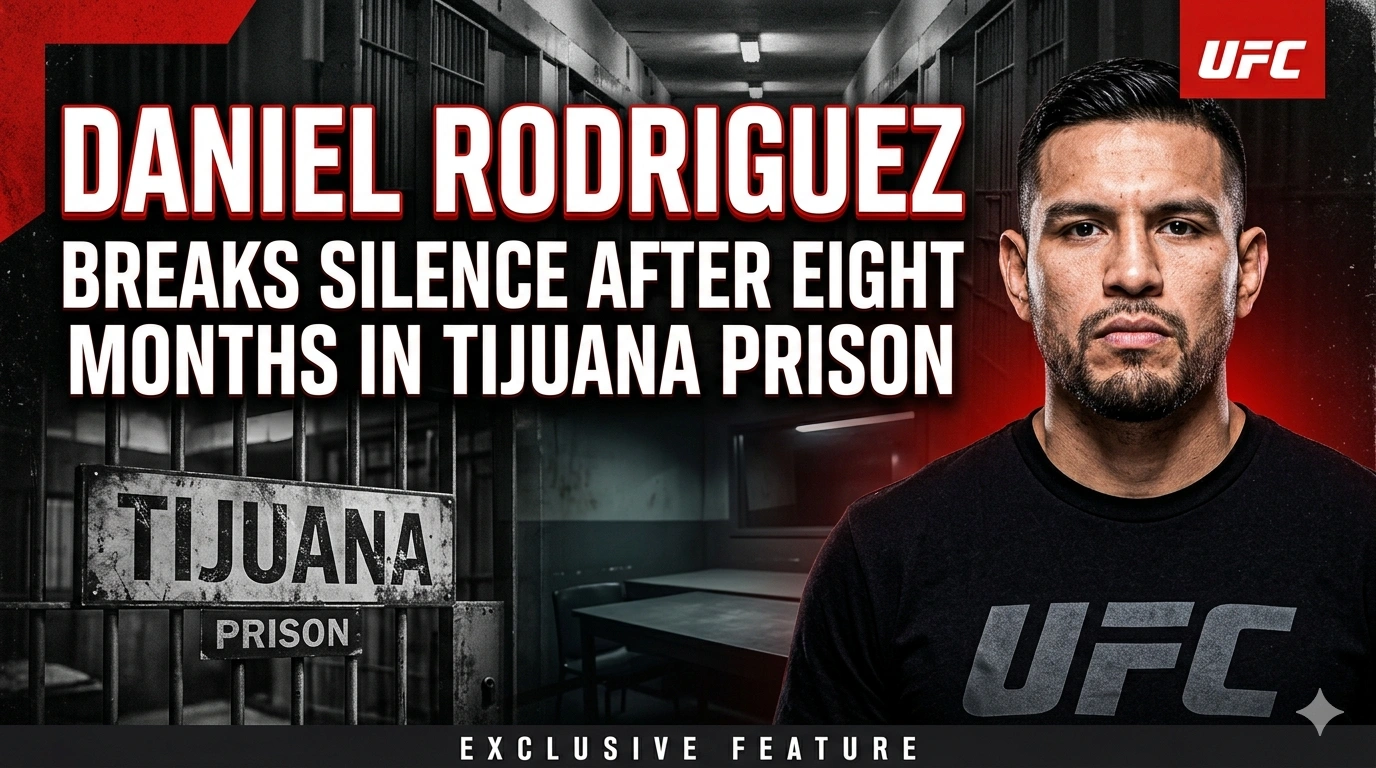
Some fighters disappear between fights. They stay off social media, skip the gym photo sessions, and avoid the MMA media cycle while they recover, train and prepare. That is normal. That is routine.
What happened with Daniel Rodriguez was not normal. It was not routine. For eight full months after his unanimous decision victory over Kevin Holland at UFC 318 on July 19, 2025, Rodriguez did not just go quiet.
He ceased to exist in any publicly observable way. No social media posts. No gym appearances in team photos. No interviews. No contract updates. No fight bookings. Nothing from his management. Nothing from the UFC.
The rumours began almost immediately. Some said legal trouble. Some said he was stuck in Mexico. Some said both.
Rodriguez’s teammates stopped appearing alongside him in the kind of casual training content that fighters post constantly. His social media accounts went completely dark. For eight months, one of the UFC’s ranked welterweights was simply gone.
On April 9, 2026, the mystery ended. Rodriguez posted a video on Instagram from inside a prison cell in Tijuana, Mexico — working out in the confined space, hitting mitts with a training partner in a prison hallway.
The caption he wrote alongside the footage was blunt, raw and entirely characteristic of a man who has always spoken about his life without softening the edges.
“8 months in a cage in Tijuana, Mexico, never killed my spirit. I did everything possible to stay on point and ready for my return to the UFC Octagon. Expect a hungrier, more focused version of myself.”
And then the line that landed across every MMA platform within hours.
“They tried to take it all away. Now it’s time for me to come back and show you all the monster prison created. Thank you to the legal and management team, family and real friends to help me be a free man today.”
Daniel Rodriguez — ranked 14th in the UFC welterweight division, on a three-fight winning streak at the time of his imprisonment — had been locked up in Tijuana for eight months. He was now free. He wanted to fight. And he was promising the most dangerous version of himself that anyone had ever seen.
The Man Behind the Story — Who Daniel Rodriguez Actually Is
Growing Up in Los Angeles — The Streets Before the Sport
To understand why Daniel Rodriguez’s reaction to eight months in a Tijuana prison is “they created a monster” rather than “I need to take time to recover,” you need to understand where Daniel Rodriguez came from before he ever threw a punch in a professional cage.
Rodriguez was born on December 31, 1986, in Alhambra, California — a city in the San Gabriel Valley of Los Angeles County. He grew up in Los Angeles in a gang-affiliated family. His own words on this, spoken in various interviews over the years, are consistently direct.
He did not grow up on the fringes of that world. He was in it. He alternated between street life and the jail system throughout his adolescence and early adulthood, getting into fights in both environments.
There was no sports background. No Little League, no high school wrestling team, no boxing gym that steered him toward athletic competition while he was young.
The fighting he did was the kind that happened in streets and corridors and holding cells, with no referee to stop it and no crowd to cheer.
He has spoken about this dynamic explicitly — comparing fighting in a jail cell to fighting in the UFC Octagon, and making clear that the streets were harder than anything the sport had put in front of him.
“There’s a referee in the Octagon,” he told TMZ Sports after his win over Mike Perry in 2021. “There’s somebody to stop it. I’ve been in situations where ain’t nobody gonna stop it. So it’s kill or be killed.”
He was not speaking hypothetically. He was describing lived experience.
The Late Start — MMA Training at 25
Rodriguez did not begin training mixed martial arts until he was 25 years old. He had some boxing background — developed through informal training rather than any formal club — but he had no competitive athletic history of any kind.
He started in Los Angeles at 10th Planet Jiu-Jitsu, fell in love with the discipline and the structure, and began competing as an amateur welterweight in 2013 at the age of 27.
He went 7-0 as an amateur. He turned professional in 2015. By any reasonable measure, he had started far too late to reach the UFC — the world’s most prestigious MMA organization — but nobody told Rodriguez that, and he did not appear to have received the message independently.
He built an 8-1 record on the regional circuit through Combate Americas, Bellator and King of the Cage before earning an appearance on Dana White’s Contender Series in 2019.
He outworked Rico Farrington in a unanimous decision. He was the only winner from that episode who did not receive a UFC contract that night.
He kept fighting. He won the Smash Global Welterweight Championship. He kept knocking on the UFC’s door. And eventually, in early 2020, the door opened — not through a standard booking but through a short-notice call.
Tim Means needed an opponent for UFC Fight Night 167 in February 2020. Rodriguez took the fight on short notice.
He submitted Means with a guillotine choke in the second round and earned a Performance of the Night bonus in his promotional debut.
He was 33 years old. He had started training MMA at 25. He had made the UFC on short notice. The ride had begun.
The UFC Career — Highs, Lows and a Three-Fight Winning Streak
The Rise Through the Welterweight Division
Rodriguez’s first two years in the UFC were among the most consistent early runs any fighter in the welterweight division had produced in recent memory.
He beat Tim Means. He knocked out Dwight Grant. He beat Gabriel Green. He beat Preston Parsons. He beat Mike Perry. He beat Kevin Lee.
His record moved to 7-1 in the UFC and he entered the welterweight top fifteen as a legitimate contender whose boxing-heavy striking, surprising submission game and relentless forward pressure made him a dangerous night for anyone in the 170-pound division.
He lost a controversial split decision to Nicolas Dalby that many observers scored for him. He won a split decision over Li Jingliang at UFC 279 — on a card that became famous for the chaos surrounding Khamzat Chimaev’s weight miss — that 21 out of 23 media members scored against him.
The results were competitive and the record after each showed a fighter who was exactly on the edge of the welterweight division’s most significant matchups.
Then the losses came more definitively. Neil Magny submitted him with a D’Arce choke in the third round. Ian Machado Garry stopped him in the first round at UFC on ABC 4 in one of the young Irishman’s most impressive early performances.
Kelvin Gastelum — in a fight that was changed to middleweight mid-week when Gastelum could not make the welterweight limit — beat him on the scorecards. Three losses in sequence. His career felt, genuinely, like it might be reaching its conclusion.
The Comeback That Preceded the Disappearance
What followed the three-fight skid was the most impressive consecutive run of Rodriguez’s UFC career. He described his October 2024 fight against Alex Morono as one where his roster spot felt genuinely at risk — and he won by split decision after starting slowly and building through the rounds.
He beat Santiago Ponzinibbio by TKO in the third round in May 2025 at UFC Des Moines — a performance that confirmed his form was real rather than circumstantial. And then he beat Kevin Holland by unanimous decision at UFC 318 in New Orleans on July 19, 2025.
Three consecutive wins. A ranked opponent in Holland. His record sitting at 20-5. His UFC ranking at number 14 in the welterweight division.
His career in the best shape it had been in years, on a trajectory that pointed toward top-ten opponents and potentially the most significant fights of his professional life.
And then, within weeks of that Holland victory, Daniel Rodriguez was in a prison in Tijuana, Mexico.
The Prison — Eight Months in Tijuana
What Is Known
The full circumstances of Rodriguez’s arrest and imprisonment in Tijuana have not been publicly disclosed at the time of writing. His management team told MMA Junkie that a detailed statement would be released in the coming days.
The UFC has made no official comment. Rodriguez’s Instagram video and caption represent the entirety of the public record on the specifics of what happened.
What is confirmed is this — he was incarcerated in a Tijuana prison for eight months. He was released in early April 2026. He maintained his training throughout the period of his imprisonment, working out inside his cell and hitting mitts with a partner in the prison hallway.
He thanked his legal and management team, his family and what he described as his “real friends” for helping him become a free man.
The absence of information about the arrest charges or circumstances reflects the fact that neither Rodriguez nor his management had released that detail by the time of publication. Rodriguez’s post did not explain what he was charged with or why he was in Tijuana at the time of his arrest.
Training Behind Bars
The video Rodriguez posted alongside his statement showed something that the MMA world reacted to with a mixture of respect and astonishment.
In the footage, Rodriguez is shown doing conditioning work inside his cell and then hitting mitts with a training partner in a prison hallway.
The quality of the pad work in the hallway clip is notably high — the combinations sharp, the footwork present, the level of athletic maintenance visible.
Eight months in a Tijuana prison and he kept the hands working. Eight months without access to a proper gym, without his coaching team, without the resources of a professional athletic training environment — and the hands were still there when he came out.
For a man who grew up in the Los Angeles jail system and described the jail environment as more dangerous than anything the UFC Octagon had produced, eight months in Tijuana was not his first experience of that world.
That context matters when reading his statement. He did not emerge from prison traumatised by an environment he had never encountered before. He emerged from prison exactly as he said he would — as a free man ready to fight.
Kevin Holland’s Claim — “I Bailed Him Out”
No coverage of Rodriguez’s prison revelation would be complete without addressing the remarkable claim made by his most recent opponent, Kevin Holland, in the days before and after the Instagram video dropped.
Holland, who was preparing for his UFC 327 fight against Randy Brown, told Full Send MMA that he had personally bailed Rodriguez out of jail — motivated entirely by his desire to run back their July 2025 fight, which he lost by unanimous decision but has disputed watching back.
“I bailed him out, man,” Holland said. “I needed to get this dub right here and then I needed to fight ‘D-Rod’, so I had to bail him out. He can get through this probation period and then, when it’s time for me to fight again, he’ll be ready.”
Holland was equally candid about the original result. “I went back and watched that fight — I don’t know how the hell I lost. Run that back two or three more times.”
Whether Holland literally paid bail money to secure Rodriguez’s release, or whether this is the kind of colourful self-mythology that Holland produces for public entertainment, is unclear.
His management did not elaborate. What is clear is that Holland wants the rematch, that Rodriguez’s return creates the exact conditions under which that rematch becomes available, and that Holland is publicly staking his desire for it in the most Holland way imaginable — by claiming personal responsibility for his opponent’s freedom.
What This Means for Rodriguez’s UFC Future
The Three-Fight Win Streak Is Still There
One of the most important practical realities of Rodriguez’s situation is that his form heading into the imprisonment was the best of his UFC career.
A three-fight winning streak — including a win over a ranked opponent in Holland — does not disappear from his record because he spent eight months in a Tijuana jail.
When he returns to the Octagon, he returns as a fighter who was 20-5 overall and ranked 14th in a division where the top fifteen changes constantly and opportunities open regularly.
His position in the division is not destroyed. His ranking may have shifted somewhat in his eight-month absence, but the record that earned that ranking is intact.
The question of his UFC contract status — whether his imprisonment triggers clauses related to conduct or whether the organisation has taken any action regarding his roster spot — is one that his management’s upcoming detailed statement may address.
The Rematch With Holland Is the Obvious First Target
Holland has made the rematch conversation unavoidable. Rodriguez beat Holland by unanimous decision in a fight Holland believes he won.
Holland has publicly claimed responsibility for Rodriguez’s release. The promotional narrative for a rematch writes itself — and more importantly, both fighters are motivated for it in ways that will produce the kind of pre-fight energy that UFC cards are built around.
A healthy Rodriguez returning from eight months of prison — having trained throughout, carrying whatever psychological intensity the experience produced — against a Holland who has been calling for the rematch loudly and publicly is exactly the kind of matchup that the UFC’s welterweight division needs.
Whether it happens as Rodriguez’s first fight back or after another fight to re-establish his form is a matchmaking question. The fight itself is inevitable.
The Welterweight Division Is Wide Open
The welterweight division in 2026 has significant movement in it. Belal Muhammad is the champion. Ian Machado Garry continues his rise. Sean Brady, Shavkat Rakhmonov and others are building their cases for title shot consideration. Below the top five, the division is competitive, active and relatively unstable in terms of ranking positions.
A Rodriguez who spent eight months training in prison — maintaining his conditioning and his technical work through sheer force of will — has the potential to re-enter that division and move quickly. He was already on a three-fight winning streak heading in.
If the imprisonment has affected his motivation and focus, as his statement suggests, the version of Rodriguez returning to the Octagon could be the most dangerous version the division has faced.
The Deeper Story — A Life That Has Always Run Parallel to This One
Rodriguez has spoken previously about his relationship with incarceration in terms that make the Tijuana reveal painful but not entirely surprising for those who followed his pre-UFC story closely.
He grew up in a world where jail was part of the cycle — not an aberration but a recurring feature of the environment he was embedded in.
He built his MMA career as an explicit alternative to that cycle, a way out that gave him structure, purpose and the kind of respect that the streets could not provide sustainably.
The UFC profile piece published by E. Spencer Kyte in April 2025 quoted Rodriguez describing his journey as “the crazy-ass journey that I never thought I would be on.”
He was talking about the UFC career, the travel, the ranked welterweight position, the fights on big cards in big arenas.
He was describing a life that had exceeded anything he could reasonably have anticipated from the starting point of Los Angeles gang culture and the jail system.
Eight months in a Tijuana prison is the old world interrupting the new one. It is the life he built the sport to escape from finding him one more time.
Whether the details that emerge in the coming days paint a picture of circumstance or choice, of mistake or misfortune, what Rodriguez does with the aftermath is the only story that ultimately matters.
He described the experience as having created a monster. He thanked the people who helped him become free. He said he was ready to return to the Octagon.
That is the language of a man who has decided that the new world wins. That the career, the ranking, the fight record and the life he built through MMA are not finished — that one more chapter of the old world did not end the story.
The Octagon has a referee. The streets do not. Daniel Rodriguez knows the difference better than almost anyone who has ever competed in the UFC.
And for the first time in eight months, he is free to go back to the one where someone stops it when things go wrong.
Key Facts About Daniel Rodriguez’s Situation
- Rodriguez posted on Instagram on April 9, 2026 confirming he had spent the past eight months in a Tijuana, Mexico prison.
- His last UFC fight was a unanimous decision win over Kevin Holland at UFC 318 in New Orleans on July 19, 2025.
- He is ranked 14th in the UFC welterweight division with a record of 20-5 overall and 10-4 in the UFC.
- He was on a three-fight winning streak at the time of his imprisonment — wins over Alex Morono, Santiago Ponzinibbio and Kevin Holland.
- His management told MMA Junkie a detailed statement about the circumstances of his arrest would be released the following week.
- The arrest details and charges have not been publicly disclosed at the time of writing.
- Rodriguez trained throughout his imprisonment — footage in his Instagram post shows him working out in his cell and hitting mitts in a prison hallway.
- Kevin Holland publicly claimed he personally bailed Rodriguez out of jail, saying he needed the rematch to happen.
- Rodriguez grew up in Los Angeles in a gang-affiliated family and has spoken previously about spending time in the jail system before discovering MMA at age 25.
- He began professional MMA training at 25 and turned professional in 2015 — making the UFC on short notice in 2020 at the age of 33.