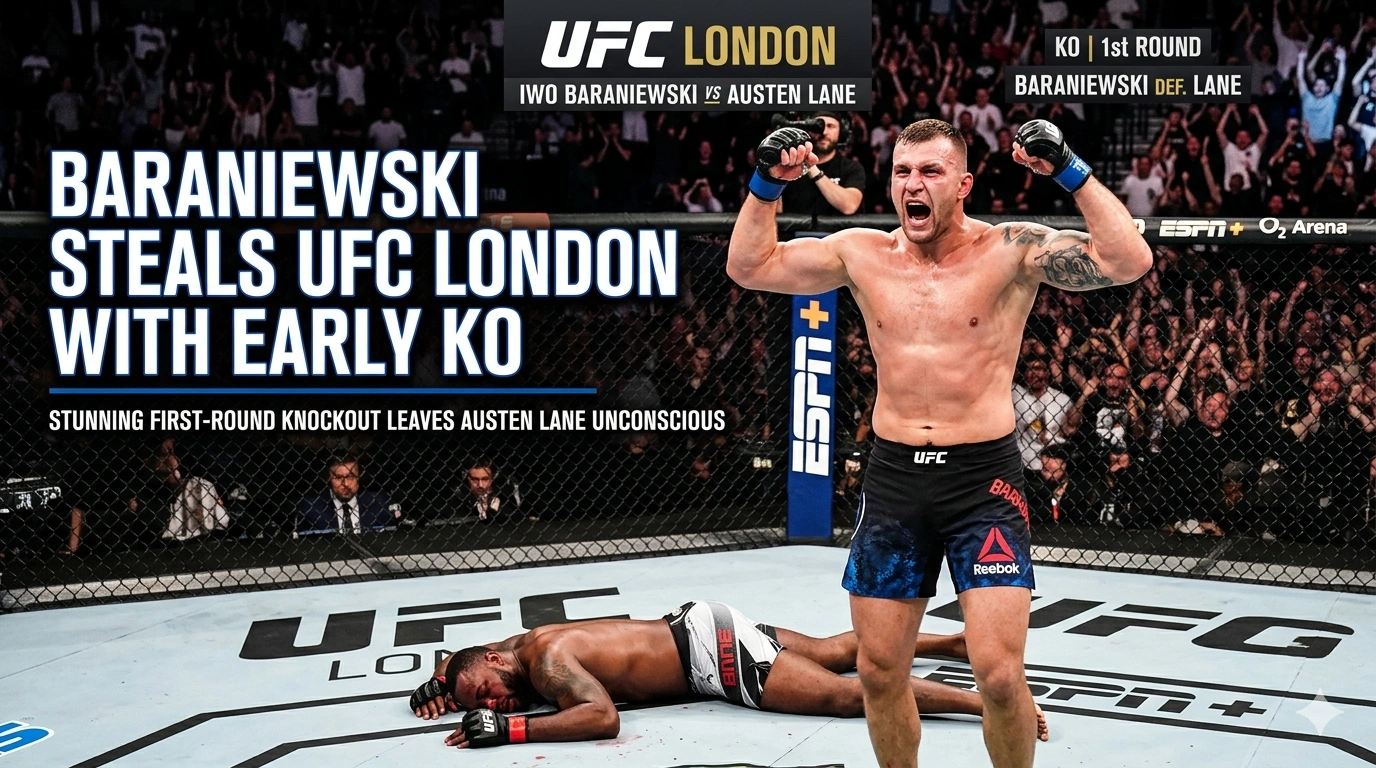
Baraniewski
OVERHAND RIGHT + LEFT HOOK
Lane
Twenty-eight seconds. One overhand right, one left hook behind it, and a swarming finish that gave the referee no choice but to wave it off. Iwo Baraniewski walked out of the O2 Arena on Saturday night with a second consecutive UFC bonus, a record that now reads 8-0 with every single win coming in the opening round, and a growing reputation as the most exciting prospect in a light heavyweight division that has been searching for exactly this kind of personality.
The performance against Austen Lane was not the barnburner that Baraniewski’s UFC debut in December produced — that fight already carries Fight of the Year conversation despite occurring barely three months ago. Saturday night was shorter, sharper, and more clinical. Lane walked forward into a right hand that buckled his legs and had no answer for the left that followed. By the time the referee stepped in, the crowd at the O2 had barely finished reacting to the opening exchanges. Baraniewski raised his hands, Lane protested the stoppage, and the instant replay left no room for argument.
Key Facts
- 🥊 Baraniewski stopped Lane at the 28-second mark of round one with an overhand right followed by a left hook — his cleanest and most efficient finish to date.
- 🏆 He earned a Performance of the Night bonus worth double the value of his debut bonus — his second straight post-fight award in as many UFC appearances.
- 📊 Every one of his eight professional victories has come in round one — a streak that has no parallel among active UFC light heavyweights.
- 🥋 A former elite-level judoka, Baraniewski holds a black belt and represented Poland at international judo competitions before transitioning to MMA. His post-fight interview referenced his desire to show more of his judo base in future performances.
- 🏋️ His UFC London camp included sparring with former UFC light heavyweight champion Jan Blachowicz and fellow O2 Arena main card fighter Roman Dolidze, training across three separate facilities in Poland and Bosnia.
- 🏈 Lane, 37, was a former NFL defensive end drafted by the Jacksonville Jaguars in the fifth round of the 2010 NFL Draft. Saturday’s defeat moved him to 1-5 in the UFC.
How the Finish Unfolded
Baraniewski’s gameplan against Lane was visible from the opening second. Lane carried a six-inch height advantage and had stepped down from heavyweight for this matchup — Baraniewski’s preparation specifically accounted for both factors, as he detailed in his post-fight media session. The Polish fighter trained extensively with larger sparring partners, including Jan Blachowicz, to prepare for the physical size differential he expected inside the cage.
What the size difference could not compensate for was the timing and precision of Baraniewski’s attack. He closed the distance immediately from the opening bell, finding the range for the overhand right within the first few exchanges. The punch landed flush and sent Lane’s legs searching for solid ground. In the fraction of a second it took Lane to process the impact, Baraniewski was already releasing the left hook that finished the sequence. Lane collapsed to the canvas, attempted to demonstrate coherence by holding himself up, and then absorbed a pair of ground and pound strikes before the referee ended it. The 28-second mark stood as the official time. Lane’s protests were understandable but unsupported by the replay.
The Camp That Made It Possible
In his post-fight media session with MMA Junkie, Baraniewski provided the most detailed account yet of how he had approached preparation for a physically larger opponent. The 27-year-old divided his camp across three facilities — his home gym in Poland, a training base in Bosnia, and a Warsaw club — deliberately seeking variety in his sparring partners and training environments.
The most significant detail was the revelation that former UFC light heavyweight champion Jan Blachowicz had served as a sparring partner during preparation. Blachowicz, who competed on the same main card at UFC London on Saturday, is one of the most accomplished knockout artists in light heavyweight history. Sparring with a fighter of his size, experience, and power while preparing for a similarly large opponent in Lane gave Baraniewski exactly the kind of reference point his gameplan required. He also worked extensively with Roman Dolidze, another fellow O2 Arena competitor, adding further depth to a camp that by all accounts was physically demanding and tactically specific.
Who Is Iwo Baraniewski? The Full Story
For fans who first encountered Baraniewski through Saturday’s 28-second highlight clip, the backstory is worth understanding. He arrived in the UFC via Dana White’s Contender Series, where he needed just 20 seconds to earn his contract — a finish so quick and emphatic that it generated significant social media attention before most viewers had settled into their seats. His UFC debut in December 2025 at UFC 323 against Ibo Aslan lasted 89 seconds and produced a finish so entertaining it entered the early conversation for MMA’s Fight of the Year. His UFC London performance was shorter and more clinical, but the pattern it reinforces is unmistakable: Baraniewski does not need a full round, and he has not needed one at any point across eight professional fights.
Before MMA, he built a competitive judo career that reached international level for Poland — a background that informs both his physical instincts and the timing he brings to close-range exchanges. The judo base gives him grappling options that have not yet been required in his UFC appearances, and he referenced them specifically in his post-fight interview with Michael Bisping, noting that future performances would showcase more of that dimension. The implication was clear: what the light heavyweight division has seen from him so far represents only a portion of his full range.
Baraniewski’s Rise: Every Finish at a Glance
What Comes Next: The Top 15 Awaits
The conversation around Baraniewski’s next fight began before the post-fight press conference had finished. MMA analysts covering UFC London were unanimous in their view that a top-fifteen opponent represents the logical and commercially appropriate next step — and the UFC’s own track record of fast-tracking hot prospects in thin divisions supports that conclusion. The light heavyweight division sits in a transitional moment, with a new champion expected to be crowned at UFC 327 in April, and a contender queue that lacks the kind of name-recognition depth available in heavier commercial divisions.
Several names emerged immediately in post-fight discussion as potential opponents. Dominick Reyes, who has been inactive but remains a recognizable name, was mentioned. Aleksandar Rakic, a ranked fighter returning from injury, would represent a genuine step up in competition. Anthony Smith, veteran and perpetually active, would provide a credible test with a marketable name. Any of those matchups, framed around a fighter who has now finished two consecutive opponents at the O2 Arena and on the Apex inside a combined time of under two minutes, becomes a compelling promotional package.
In a sport that regularly produces overnight sensations who fade just as quickly, Iwo Baraniewski has earned the right to be taken seriously. He is 8-0, 27 years old, and has finished every opponent he has faced in round one — at every level, in every setting, on every stage. He trained with a former light heavyweight world champion for this camp and needed 28 seconds to demonstrate what he absorbed from those sessions. If the UFC places him opposite a ranked opponent in his next fight, the light heavyweight division may be about to get a great deal more interesting.
Also Read- Lerone Murphy Robbed At UFC London